My journey with The Goal
I recommended the audiobook because the story feels alive, but the bigger surprise was how directly a forty-year-old manufacturing novel mapped to modern AI adoption.
The Goal: A Process of Ongoing Improvement, first published in 1984 by Eliyahu M. Goldratt with Jeff Cox, follows plant manager Alex Rogo as he tries to save a failing factory. Instead of a tidy management checklist, the book lets the reader discover the Theory of Constraints alongside Alex — through missed targets, overloaded resources, growing inventory, and a mentor named Jonah who keeps responding with better questions.
I recommended the audiobook because the dramatized production makes the story feel less like assigned reading and more like overhearing a company unravel in real time. The factory setting is dated. The management problems are not.
And this floored me: Jeff Bezos reportedly hosted all-day book clubs with Amazon's top executives and included The Goal among three books used as frameworks for thinking about Amazon's future. Senior leaders weren't reading it for nostalgia — they were using it to sketch the future of one of the world's most consequential operating systems. Source →
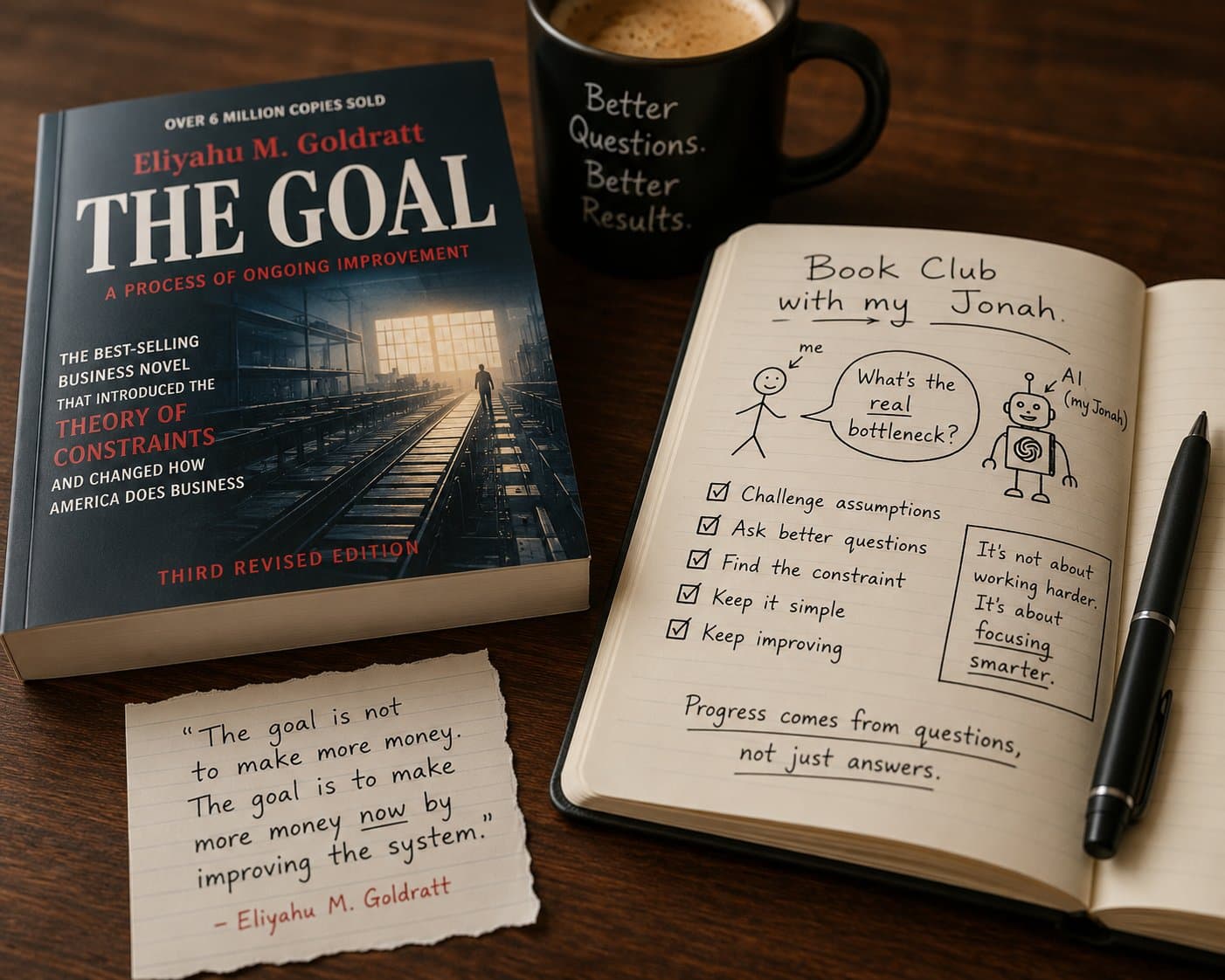
Where the joke started — the book, the coffee, and the doodle that turned into a running bit.
I expected a dated factory story.
The smoking, the workplace culture, and the old industrial setting all felt unmistakably from another era.
Then the concepts became uncomfortably current.
Busy people, local optimization, false productivity, overloaded constraints, and measurements that reward the wrong behavior all looked familiar.
I connected it to my own projects.
I had been automating reports, comparing data, improving forecasting, building dashboards, and linking workflows. Every improvement helped, but then another bottleneck formed.
The bottleneck was moving.
That was not failure. It was evidence that the first constraint had been relieved.
I called AI "my Jonah."
The joke landed because Jonah did not hand Alex answers. He asked questions that changed how Alex saw the system. That is exactly how I had begun using AI.
inside the work
What is really limiting flow?
asks what comes next
The insight
The new bottleneck is evidence that the system changed. AI sits beside the operator, not above them.
I began experimenting with AI because I needed leverage. My workload was not theoretical. It was meetings, overlapping priorities, reporting, operational follow-up, data reconciliation, process design, and work that often continued after the formal workday ended.
At first, I measured success by time saved. A report that once took hours could be completed much faster. Those were real wins.
But something kept happening. I would improve one area, celebrate the progress, and then discover that the delay had moved somewhere else. The next approval became the issue. Then data quality. Then ownership. Then trust.
The Goal gave me language for what I was already observing: every system has a constraint, and improving a non-constraint does not necessarily improve the system.
That changed my AI question from "What can I automate?" to "What is preventing value from flowing?"
AI as a Socratic teammate
Clarify
What do we mean by productivity, throughput, utilization, or value?
Challenge assumptions
Why do we believe every resource must stay busy?
Trace consequences
What happens downstream when this step accelerates?
Test evidence
Which measure proves the system actually improved?
Find the next question
Now that this changed, what became the new constraint?
A real-life Socratic flow
"Customers keep asking for order updates. Should we automate more emails?"
Symptom
Status requests
inbox volume rises
Clarify
What are they really missing?
timing, ownership, certainty?
Challenge
Is email volume the constraint?
or missing source data?
Constraint
Status changes aren’t captured reliably
automation would echo bad data
Focused Change
Fix capture, then automate
measure repeat requests
The first solution was "send more updates." The better solution was "repair the information flow." AI belongs after the constraint is understood, not before.