The Builder Architecture
How AI adoption moves from prompting to building — and why the resulting work should survive a change in model, tool, or platform.
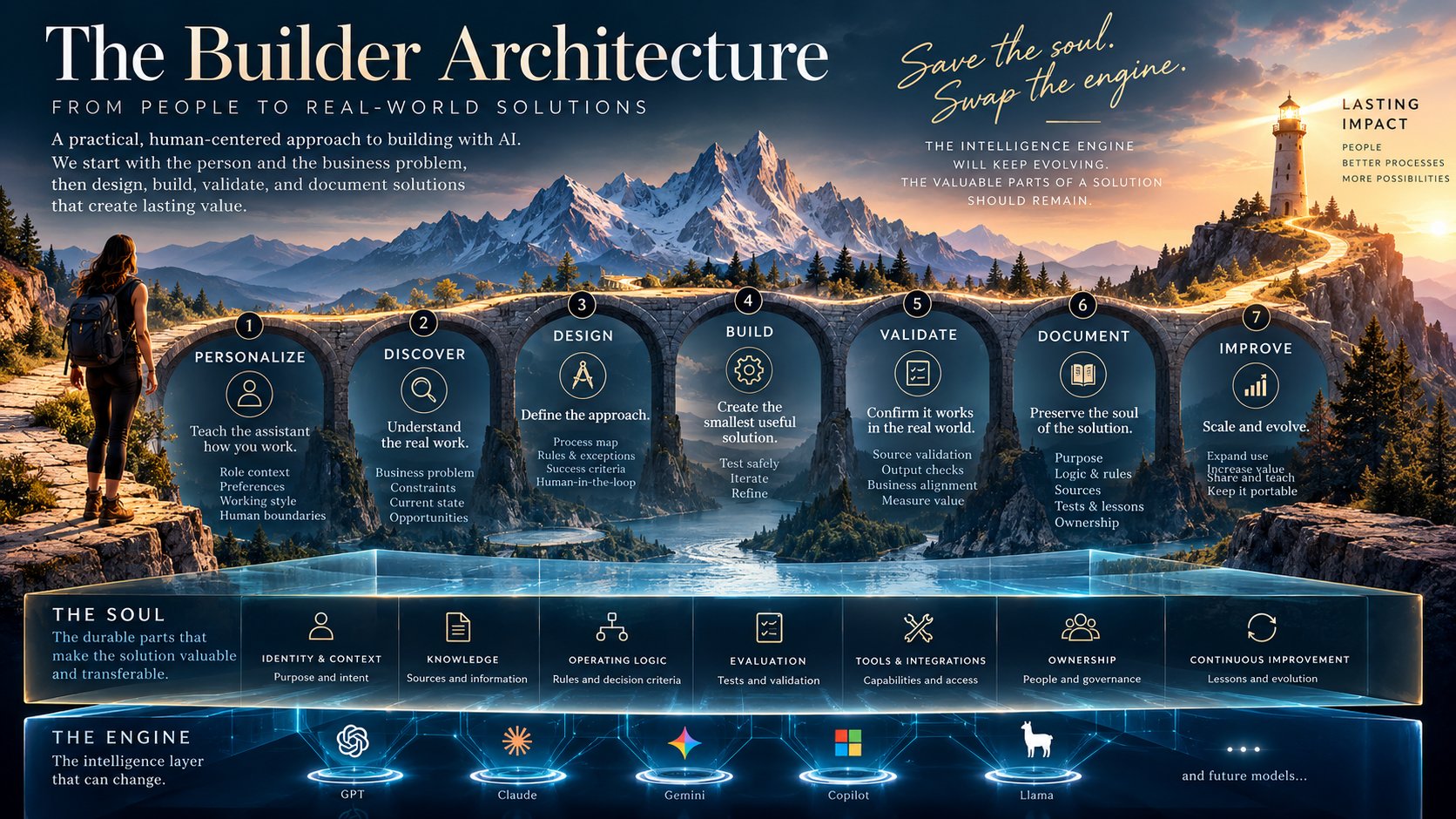
Most AI adoption starts with the tool: which model, which agent, which automation should solve this. That starts one layer too late. Before any of that, the more useful question is about the person, the work, the actual constraint, and what has to stay human-owned no matter what. This is the framework behind that question — tested first on my own projects, then taught to other people as a repeatable way of working with AI. It moves someone from using AI on isolated tasks to building with it: personalize the collaboration, separate stable preferences from process-specific logic, discover the real constraint before picking a feature, build the smallest safe version, validate it against reality — not just against a demo — document why it exists and how it works, and improve it like any other system. The AI accelerates every step of that. The human still owns the problem, the logic, and the decision.
Personalize, Then Separate
Stable collaboration preferences — tone, format, how uncertainty gets handled — go in one place. Sources of truth, rules, exceptions, and approval points go with the process they belong to. Mixing the two turns personalization into a dumping ground for logic nobody can audit.
Discover Before You Build
A problem statement and a named constraint come before a tool gets chosen — not the other way around. Tool-first adoption asks what AI can do. This asks what should actually improve, and what must stay human-owned regardless.
Small, Then Validated
The smallest testable version first, checked against normal cases, edge cases, and conflicting data — not just the happy path — before it earns more scope.
Document the Soul
Purpose, authoritative sources, rules, exceptions, ownership, test evidence, and the reasoning behind key decisions, recorded outside the AI conversation itself — so another qualified person could run it without needing the original chat history.
Two Layers, One Instinct
A business process has a soul worth preserving: purpose, rules, decisions, value. A long-running AI collaboration has a different one: identity, memory, learned working patterns. They're separate portability problems, but the same design answer applies to both — keep the durable meaning out of the replaceable engine. Project Lighthouse is the early research into the second one.
This runs underneath the other projects on this site, not just behind the scenes. Battle of the Bots already lives it in miniature — the trading rules, thresholds, and regime logic are stored as versioned config, not buried inside a one-off prompt, which is a real part of why the strategy survived a market crash, a full regime-filter rewrite, and a relaunch without starting from zero. The same framework is now also being taught to other people, outside this site, as a way of working with AI rather than a one-time project.